sonomono® Products


Sprinkle, mix, and enjoy!
Articles
Supervised by experts

Kazuya Ogasawara

Emi Hidaka

Sentaro Kimura
sonomono® Products
Sprinkle, mix, and enjoy!
Supervised by experts
Kazuya Ogasawara
Emi Hidaka
Sentaro Kimura
| Ingredient | REGULAR type | MILD type | |||
|---|---|---|---|---|---|
| Name | Unit | /per 100g | /per 1.5g(*2) | /per 100g | /per 1.5g(*2) |
| Energy | kcal | 439 | 7 | 442 | 6.63 |
| Protein | g | 40.2 | 0.60 | 41.2 | 0.62 |
| Lipid | g | 22.0 | 0.33 | 22.2 | 0.33 |
| Carbohydrate | g | 27.9 | 0.42 | 26.5 | 0.40 |
| ∟Sugar | g | 12.3 | 0.18 | 12.4 | 0.19 |
| ∟Dietary fiber | g | 15.6 | 0.23 | 14.1 | 0.21 |
| Salt equivalent | g | 0.02 | 0.0003 | 0.03 | 0.00045 |
| Ingredient | REGULAR type | MILD type | |||
|---|---|---|---|---|---|
| Name | Unit | /per 100g | /per 1.5g(*2) | /per 100g | /per 1.5g(*2) |
| Dietary fiber (soluble and insoluble) |
g | 16.4 | 0.25 | 15.6 | 0.23 |
| ∟Water-soluble dietary fiber | g | 7.2 | 0.11 | 5.7 | 0.09 |
| ∟Insoluble dietary fiber | g | 9.2 | 0.14 | 9.8 | 0.15 |
* Measured by enzyme gravimetric method (Prosky variant)
| Ingredient | REGULAR type | MILD type | |||
|---|---|---|---|---|---|
| Name | Unit | /per 100g | /per 1.5g(*2) | /per 100g | /per 1.5g(*2) |
| Potassium | mg | 1760 | 26.4 | 1730 | 25.95 |
| Calcium | mg | 190 | 2.85 | 280 | 4.2 |
| Magnesium | mg | 240 | 3.6 | 254 | 3.81 |
| Phosphorus | mg | 770 | 11.6 | 750 | 11.25 |
| Iron | mg | 7.1 | 0.1065 | 6.5 | 0.0975 |
| Zinc | mg | 4.3 | 0.065 | 4.9 | 0.0735 |
| Copper | mg | 1.2 | 0.018 | 1.1 | 0.0165 |
| Manganese | mg | 2.7 | 0.041 | 3.2 | 0.048 |
| Ingredient | REGULAR type | MILD type | |||
|---|---|---|---|---|---|
| Name | Unit | /per 100g | /per 1.5g(*2) | /per 100g | /per 1.5g(*2) |
| Vitamin E (α-tocopherol) |
mg | 2.7 | 0.041 | 5.2 | 0.078 |
| Vitamin K | μg | 1126 | 16.89 | 1038 | 15.57 |
| ∟Vitamin K1 (ferroquinone) |
μg | 26 | 0.39 | 36 | 0.54 |
| ∟Vitamin K2 (Menaquinone-7) |
μg | 1100 | 16.50 | 1000 | 15.00 |
| Vitamin B1 (Thiamine) |
mg | 0.10 | 0.0015 | 0.14 | 0.0021 |
| Vitamin B2 | mg | 0.43 | 0.0065 | 0.56 | 0.0084 |
| Vitamin B6 | mg | 0.69 | 0.010 | 0.77 | 0.012 |
| Folic acid | μg | 120 | 1.8 | 280 | 4.2 |
| Pantothenic acid | mg | 4.3 | 0.065 | 4.7 | 0.071 |
| Biotin | μg | 31 | 0.465 | 37 | 0.555 |
| Ingredient | REGULAR type | MILD type | |||
|---|---|---|---|---|---|
| Name | Unit | /per 100g | /per 1.5g(*2) | /per 100g | /per 1.5g(*2) |
| Arginine | mg | 2820 | 42.30 | 2980 | 44.70 |
| Lysine | mg | 2490 | 37.35 | 2650 | 39.75 |
| Histidine | mg | 1130 | 16.95 | 1180 | 17.70 |
| Phenylalanine | mg | 2210 | 33.15 | 2330 | 34.95 |
| Tyrosine | mg | 1580 | 23.70 | 1620 | 24.30 |
| Leucine | mg | 3440 | 51.60 | 3600 | 54.00 |
| Isoleucine | mg | 1840 | 27.60 | 1940 | 29.10 |
| Methionine | mg | 605 | 9.08 | 615 | 9.23 |
| Valine | mg | 2050 | 30.75 | 2120 | 31.80 |
| Alanine | mg | 1840 | 27.60 | 1980 | 29.70 |
| Glycine | mg | 1800 | 27.00 | 1890 | 28.35 |
| Proline | mg | 2180 | 32.70 | 2280 | 34.20 |
| Glutamic acid | mg | 9140 | 137.10 | 8520 | 127.80 |
| Serin | mg | 2280 | 34.20 | 2360 | 35.40 |
| Threonine | mg | 1710 | 25.65 | 1790 | 26.85 |
| Aspartic acid | mg | 4930 | 73.95 | 5140 | 77.10 |
| Tryptophan | mg | 583 | 8.75 | 570 | 8.55 |
| Cystine | mg | 674 | 10.11 | 663 | 9.95 |
| Ingredient | REGULAR type | MILD type | |||
|---|---|---|---|---|---|
| Name | Unit | /per 100g | /per 1.5g(*2) | /per 100g | /per 1.5g(*2) |
| Linoleic acid | g | 10 | 0.150 | 11 | 0.165 |
| α-linolenic acid | g | 1.5 | 0.023 | 1.3 | 0.020 |
| Soy isoflavone aglycone | mg | 170 | 2.55 | 120 | 1.80 |
| Nattokinase activity(*3) | FU/g | 24,900 | 373.5 | 5,030 | 75.45 |
| Detection Limit | Normal Type | |
|---|---|---|
| Cesium-134 | 13Bq/kg | Not Detected |
| Cesium-134 | 12Bq/kg | Not Detected |
| Detection Limit | Mild Type | |
|---|---|---|
| Cesium-134 | 14Bq/kg | Not Detected |
| Cesium-134 | 8.8Bq/kg | Not Detected |
| Analysis Test Items | Analysis Results | |
|---|---|---|
| Pesticide Residue Test(※5) | FOODS_008 (271 items) | Not detected |
| Non-GMO testing(※6) | DNA sequences derived from genetically modified crops | Not detected |
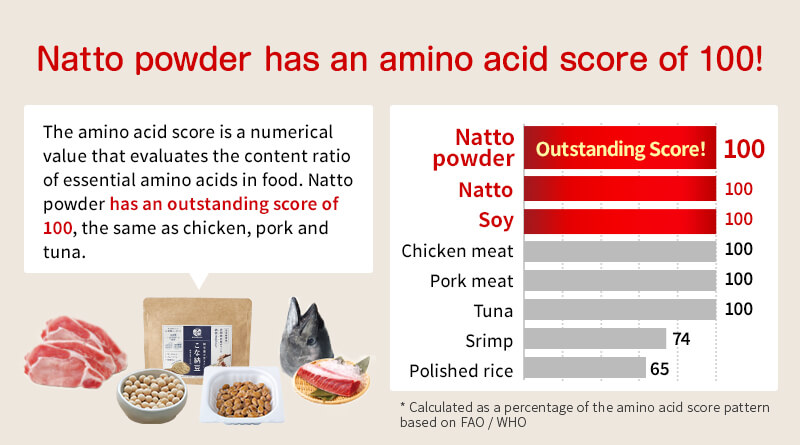
Amino acids are the smallest unit and component of proteins. They make up about 20% of our bodies or about 50% of our solid body mass. The amino acid score is a method for assessing the nutritional value of foods based on the content of essential amino acids. Food with a 100 score contains all the essential amino acids in a well-balanced manner. Soy features an outstanding 100 amino acid score, which places it as a high-quality protein source comparable to chicken, pork, tuna, and eggs.


Fit Keyaki 602, 2-16-6 Kego, Chuo Ward, Fukuoka, 810-0023, Japan
Customer support
Legal and Corporate Information
Ordering and Inquiries by Phone
Attention available only in Japanese.
Operating Hours: 9:00 AM to 5:00 PM(Closed on weekends and Japanese holidays)
For Media Coverage or Lecture Requests

Operating Hours: 1:00 PM to 5:00 PM (Weekdays only)※Click here for inquiries regarding business purposes.
Please input the required information and submit. We will respond from the next business day.