sonomono® Products


Sprinkle, mix, and enjoy!
Articles
Supervised by experts

Kazuya Ogasawara

Emi Hidaka

Sentaro Kimura
sonomono® Products
Sprinkle, mix, and enjoy!
Supervised by experts
Kazuya Ogasawara
Emi Hidaka
Sentaro Kimura
Natto is a traditional Japanese fermented food with over a thousand years of history as part of the Japanese diet. It has gained global attention as one of the healthiest foods. Made simply from soybeans and natto bacteria, natto undergoes a fascinating and complex fermentation process. During fermentation, natto bacteria produce numerous beneficial substances that contribute to our health.
Examples of Beneficial Compounds Produced by Natto Bacteria
Nattokinase, polyamines, polyglutamic acid, natto peptides, vitamin K₂, 5-ALA (5-aminolevulinic acid), oligosaccharides, dietary fiber, natto bacteria.

For natto bacteria to produce these beneficial compounds in our bodies and support gut health, they need to reach the intestines alive. But did you know that not all natto bacteria can survive the journey to the intestines?
The biggest challenge for natto bacteria to reach the intestines alive is stomach acid. Stomach acid not only digests food but also sterilizes bacteria and pathogens entering the stomach. Unfortunately, this means that most beneficial bacteria, like lactic acid bacteria and bifidobacteria, are destroyed by stomach acid.
So, how do natto bacteria survive the harsh stomach acid and make it to the intestines alive?
The secret lies in the “spore form” that natto bacteria possess.
Natto bacteria have a rod-like shape, classifying them as bacilli. Their size varies depending on their growth conditions and stage of development, with a shorter diameter of about 1 µm and a longer length of 3–5 µm. The spores formed within the cells are even smaller, with a diameter of less than 1 µm. To put it into perspective, 1 µm is 1/1,000 of a millimeter, making natto bacteria incredibly tiny and invisible to the naked eye.
Natto bacteria alternate between two life cycles: the “vegetative cell” stage, where they are actively growing, and the “spore” stage, where they enter a dormant state.
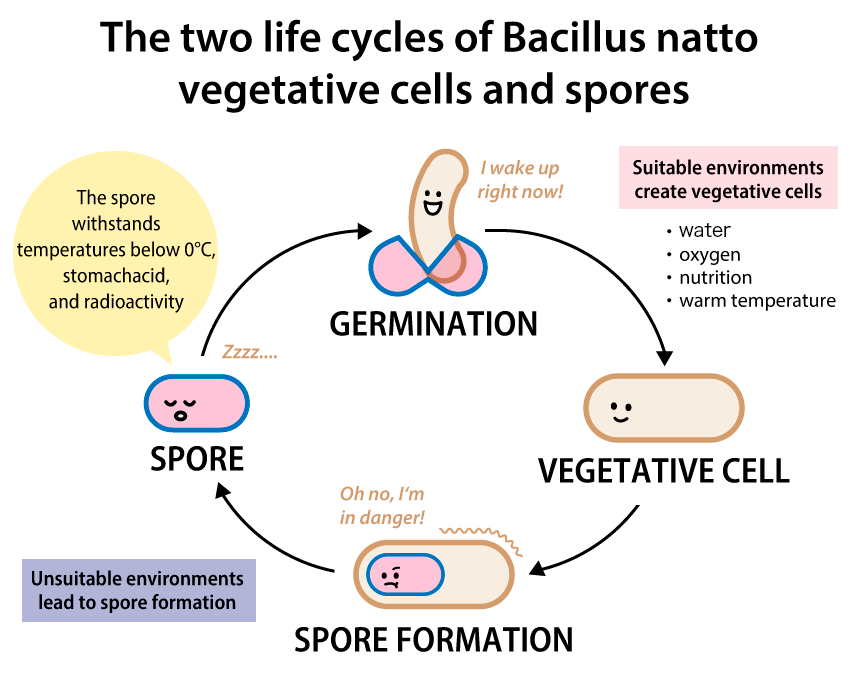
In general, it is thought that most of the natto bacteria in the “raw natto” are in the “vegetative cell” state. This is because it is surrounded by moderate water, nutrients, and oxygen, and is fermented at the appropriate temperature (30 to 45°C), which is an environment suitable for growth. Therefore, it is thought that many of the natto bacteria in raw natto are defeated by stomach acid before reaching the intestines.
On the other hand, when fresh natto is freeze-dried and powdered into “powdered natto,” the bacteria are exposed to conditions unsuitable for growth during production. As a result, they enter the spore state. In this state, natto bacteria are resistant to stomach acid and are more likely to survive the journey to the intestines.

The natto bacteria found in the fresh natto packs we usually eat are primarily in the “vegetative cell” state. This is because fresh natto provides ideal conditions for growth, including adequate moisture, nutrients, oxygen, and optimal fermentation temperatures (30–45°C). However, in this state, most natto bacteria are believed to succumb to stomach acid before reaching the intestines.
On the other hand, when fresh natto is freeze-dried and ground into “powdered natto,” the bacteria are exposed to less favorable growth conditions during production. This causes them to transition into the “spore” state. Spores are highly resistant to stomach acid, making it more likely for these natto bacteria to survive and reach the intestines alive.
To test this hypothesis, we filmed a video for scientific verification. It compares the survival of natto bacteria from fresh natto (vegetative cells) and spore bacteria from powdered natto as they face stomach acid and travel to the intestines. Watch the video to discover which bacteria make it through!
※The material of this video features sonomono natto bacteria. Each strain of natto bacteria has unique traits, therefore the findings shown in this video may not apply to natto bacteria from other companies. The results shown in this video are specific to sonomono natto bacteria TM.
The scientific visuals and footage were produced by ICAM Co., Ltd., a company renowned for its expertise in creating science-based videos with exceptional production quality.
In the following sections, we explain the contents of the video through text. Let’s take a closer look at the vegetative cells and spores of sonomono natto bacteria.
First, image of the vegetative cells. In the image, the black, rod-shaped structures are the vegetative cells of natto bacteria. Some appear connected, showing the formation of bacterial chains.

Next, let’s examine the spore state of the bacteria. Under the microscope, the spores appear as small, bluish-white spheres.

These images were captured using a phase-contrast microscope, rather than a standard optical microscope. A phase-contrast microscope is designed to clearly observe microorganisms and cells, which are typically colorless and transparent while keeping them alive during observation.
Let’s now compare the bacteria in fresh natto and natto powder. Notice that both samples were fermented with sonomono natto bacteria.

This comparison confirms that fresh natto predominantly contains natto bacteria in the vegetative cell state, while powdered natto contains bacteria mainly in the spore state.
※Note. The black dots visible in the background of the spores’ image are solid particles from the powdered natto. These cannot be removed but are distinguishable from spores due to their different size and shape, confirming they are not natto bacteria.
Next, we scientifically examined how vegetative cells (from fresh natto) and spores (from powdered natto) react when exposed to stomach acid.
This experiment simulates the journey of natto bacteria from ingestion, through exposure to stomach acid, and their eventual arrival in the small intestine. Here’s the method:
Preparation of Microscope Slides
Exposure to Stomach Acid
Restoration to Original Conditions
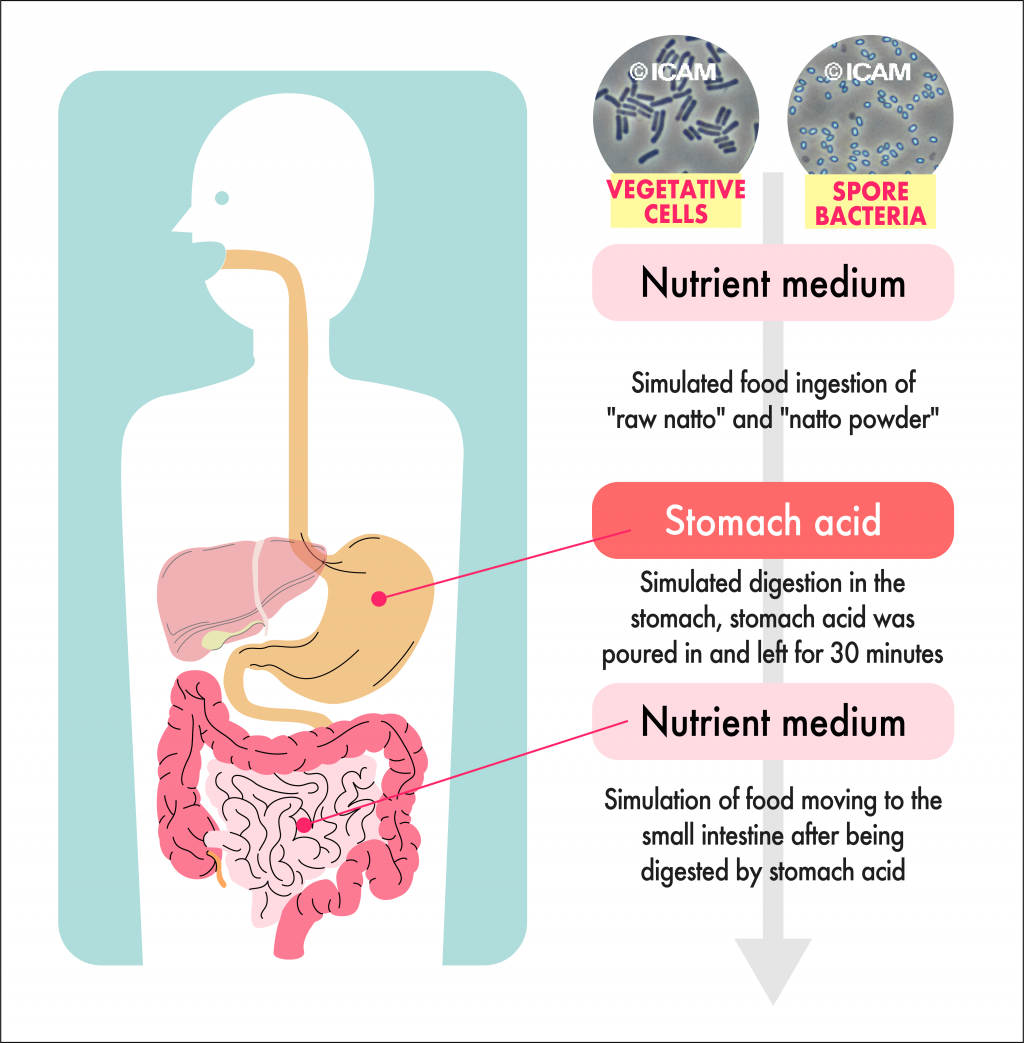
The design of this experiment replicated:
※Note. Nutrient medium refers to a gel made of water-soluble nutrients and agar, essential for the growth of natto bacteria.
Left: Vegetative Cells
On the left side, vegetative cells are actively multiplying on the nutrient medium, indicating they are alive and thriving.
Right: Spores
In contrast, the spores on the right side remain in a dormant state and show no changes on the nutrient medium over a short period.

Introducing Stomach Acid
To replicate digestion in the stomach, gastris acid is added. The vegetative cells on the left shrink and stop moving. Changes in their surface color and texture are visible, indicating the acid has caused significant damage to the cells. Meanwhile, the spores on the right remain entirely unaffected.

Thirty minutes after exposure to stomach acid, a nutrient medium is added to simulate conditions in the small intestine, neutralizing the acid and restoring the original environment.

After three hours, the vegetative cells emerging from the spores continue to grow actively, thriving in the restored environment. The vegetative cells on the left remain inactive.

Four hours later, the vegetative cells derived from the spores have spread across the field, showing vigorous growth. Transparent, circular remnants of the spores are visible at the tips of the bacterial structures. On the left side, the vegetative cells have shown no changes since their initial exposure to stomach acid.

After six hours in the intestine simulated environment, the natto bacteria grown from the spores have filled the entire field, demonstrating continued proliferation.

This experiment reveals that sonomono natto bacteria in spore form can withstand stomach acid and resume active growth when returned to their original environment (with nutrients, moisture, oxygen, and optimal temperature). This proves that spore-form sonomono natto bacteria can survive the acidic environment of the stomach, reach the intestines, and become active again.
In contrast, vegetative cells of natto bacteria commonly found in fresh natto are annihilated by the stomach acid. Even after four hours, they remain inert, with their structure visibly damaged immediately after contact with the acid. This highlights the potent digestive power of stomach acid, which typically breaks down food and microorganisms, allowing nutrients to be absorbed in the small intestine.
For natto bacteria to effectively benefit the gut, consuming just any form of them is not enough. Only spore-form natto bacteria can withstand stomach acid and reach the intestines to activate.
Once active in the intestines, these natto bacteria help improve gut health by:
By creating an environment favorable for beneficial bacteria, sonomono natto bacteria contribute to maintaining a balanced gut microbiome. To support gut health, it is essential to consume natto bacteria in their spore form, as only they can survive the journey through the stomach to the intestines.
This experiment demonstrated that, unlike bacteria of raw natto, the spore-form sonomono Natto Bacteria survive stomach acid and reach the intestines alive. As we explained at the beginning, this result may not apply to natto bacteria other than sonomono Natto Bacteria. If another natto company wants to demonstrate the survivability of its natto bacteria, that company needs to replicate our experiment with its own natto bacteria strain. Below are products that use the original sonomono Natto Bacteria. If you’re interested, give them a try!
100% natto, made with soybeans grown in Kohoku Town, Saga Prefecture, cultivated without chemical pesticides or fertilizers, and fermented with sonomono Natto Bacteria TM. Our proprietary freeze-drying technology allows the efficient intake of natto’s nutrients and “spore-form natto bacteria.” Use to boost the flavor and nutrition of your favorite food.


Pure freeze-dried natto powder, fermented with the exclusive sonomono Natto Bacteria. The soybeans of this premium product are grown without chemical pesticides or fertilizers in Kohoku Town, Saga Prefecture. The powder is encapsulated in plant-based hard capsules, gentle to the body. The easiest way to incorporate natto’s nutrients and “spore-form natto bacteria into your daily routine.


This experiment was conducted using a phase-contrast microscope, allowing for continuous video recording over extended periods. Achieving this level of precision required highly specialized equipment, scientific expertise, and extensive technical experience in life sciences. In collaboration with ICAM Co., Ltd., we undertook numerous trials over six months, refining the experiment methodology and techniques to deliver accurate and compelling results.
If these findings have helped you to understand the mechanisms behind the remarkable resilience of sonomono spore-form natto bacteria, then our efforts have been well justified.
At Sonomono Inc., we are dedicated to advancing natto food science and establishing a robust foundation of evidence for our products. We sincerely value your interest and support as we continue our journey to pioneer innovation in health and wellness.
Fit Keyaki 602, 2-16-6 Kego, Chuo Ward, Fukuoka, 810-0023, Japan
Customer support
Legal and Corporate Information
Ordering and Inquiries by Phone
Attention available only in Japanese.
Operating Hours: 9:00 AM to 5:00 PM(Closed on weekends and Japanese holidays)
For Media Coverage or Lecture Requests

Operating Hours: 1:00 PM to 5:00 PM (Weekdays only)※Click here for inquiries regarding business purposes.
Please input the required information and submit. We will respond from the next business day.